Dr. Doug Cardell
An Eclectic Economist Explains Evidentiary Economics
Clear Thinking in a Complicated World
“Ideology asks for acceptance—Intelligence asks for evidence.”
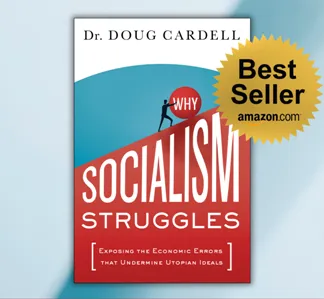
Why Socialism Struggles
Featured Article:


It's hard to look at the news nowadays and not see at least one article saying that the rich aren't paying their fair share. Let's put that claim under a microscope and see what the rich take from society and what they provide. We could examine any of the super-rich, but let's put the third richest man in the world, Jeff Bezos, on our microscope slide and see what we can learn. Bezos has a net worth of about 175 billion dollars. Those who want to see Bezos taxed far more heavily are quick to point out that this is about a million times greater than the median wealth of the country. These articles decry this as ridiculously unfair. They say, why should anyone be a million times richer than the rest of us? Let's take a look through our microscope. These articles only look at one side of the story; let's be smart and look at both sides. First, a short disclaimer: I don't know Jeff Bezos, I don't own stock in Amazon or any other Bezos company, and I know next to nothing about his personal life or political leanings. If you have objections to his personal life or politics, OK, but that's not what we're examining here. We are using him as an example of the ultra-rich, nothing more. Let's start by finding out what Bezos, by way of Amazon, does for its customers. As the largest online seller, Amazon has tremendous power to bring down prices, and it does. As a result, shopping at Amazon is typically about seven percent less expensive than shopping at brick-and-mortar locations. Amazon has 230 million US customers annually, saving an average of $1300 each. As a result, US customers have a combined savings of 299 billion dollars. This savings is two-thirds more than Bezos' total net worth every year. One might object that they only saved $1300, but that's $1300 in free money, and you don't even have to pay income tax on it. Do you believe that taxing Bezos more would get you more money than that? Now, let's examine job creation and see what happens there. Amazon employs about 1.1 million people in the US at an average annual salary of $74619. That's a total of 82,080,900,000. That's almost half of Bezos' total next worth every year. In fact, Amazon employs about one out of every 153 American workers. In addition, Amazon pays these workers over 50% more than the industry average. Amazon raised its minimum wage to $15/hr in 2018, and now the lowest-paid employee earns $16 per hour. But there's still more. Shopping online saves time and gas. Research suggests the typical physical store trip takes about an hour. If you assume that a typical Amazon purchase takes 15 minutes and that, as a result, you save two trips a week, you've saved more than 75 hours a year at the mean annual hourly rate, that's $1875 per year per person. You can multiply your hourly rate by 75 hours to find your net savings. Multiply that by Amazon's 230 million customers, and you get 431,250,000,000, or about two and a half times Bezos's net worth every year. There's still more; all those trips to the store cost you gas money. Let's see how much. Driving 120 miles (eight 15-mile trips) to a store every month means spending an average of $19.20 on fuel/per month or $230.40 per year. Again, multiplied by Amazon's 230 million US customers yields $52,992,000,000 saved annually. Four years of savings would be more than Jeff Bezos's net worth. Driving creates CO2 emissions at the rate of .00889 metric tons per gallon burned. Those eight trips to the store you saved each month also saved 4.8 gallons of gas, or 57.6 gallons per year. Multiply by the number of metric tons per gallon for 230 million customers, and we find that Amazon prevented 117,774,720 metric tons of CO2 from being released into the atmosphere. You may say that Amazon is still shipping those packages, and that's true, but Amazon ships those packages on routes already being traveled, so the result is like taking the bus instead of driving a car. To summarize, Bezos saved the average customer, 230 million Americans, $299 billion per year in costs of goods, $431 billion/year in shopping time, and $53 billion/year in gasoline expenses. If you happen to be a typical Amazon customer, your 'Bezos Bonus' is about $3400 annually. In addition, Amazon boosted the US economy by paying $82 billion/year in wages. Amazon returns about 865 billion to the US economy every year. Bezos accumulated his net worth over the 30 years since he started Amazon. So he took about 6 billion per year for himself and contributed $865 billion yearly. This is an example of the unappreciated reality described in my article, More Pie Please. The six billion per year Bezos used to create his wealth is less than one percent of his contribution to the American economy. This article is not really about Jeff Bezos. Mr. Bezos is just an example of how wealthy entrepreneurs contribute to the economy. Nine of the ten richest people in the world are Americans, and none of them inherited their wealth. Today, there are thousands of budding entrepreneurs hoping to create the next big thing. Increasing taxes on the wealthy or instituting a wealth tax sends a message to these folks that it might not be worth the effort if the government takes it all anyway. Is the country better off with ultra-rich company founders and the out-sized boost they give the economy? Or would the country be better off with middle-class would-have-been-entrepreneurs and no new products or services to boost the economy and make everyone a little richer? You can't have both!
If you found this article stimulating, you'll probably love my book, Why Socialism Struggles. If you share my concern about creeping socialism, please share this article with other folks who might enjoy it and link to it on your social media. And please share your thoughts below. Dr. Cardell would love to hear from you.
Questions, Comments, Criticisms, or Witty Remarks:
Recent Articles
Newest to Oldest
Contact Us
Dr. Doug would love to hear from you:

Copyright © 2018 - 2026 DougCardell.com. All rights reserved.

![[Valid RSS]](valid-rss-rogers.png "Validate my RSS feed")
Responses